
dejar un mensaje
Si le interesan nuestros productos y desea obtener más información, deje un mensaje aquí y le responderemos lo antes posible.




¡La mejor compra que he hecho este invierno! El color y el tejido son exquisitos, ¡y es comodísimo! Viajé de Nueva York a Miami sin quitármelo ni una sola vez. ¡Es monísimo!
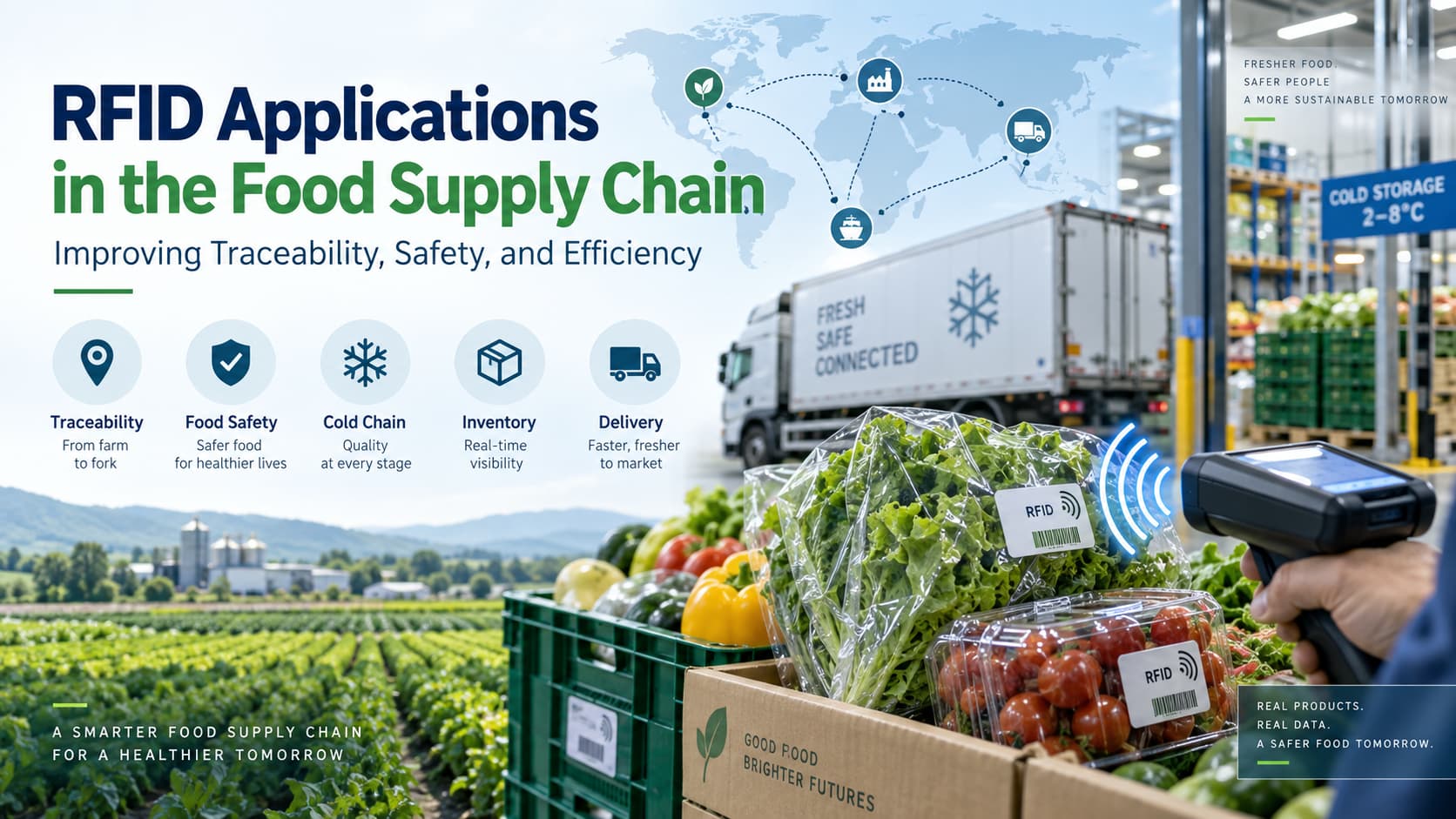
The global food supply chain has become increasingly complex, involving multiple stages from agricultural production and processing to transportation, storage, and retail distribution. As consumers demand safer food products, governments strengthen food safety regulations, and companies seek greater operational efficiency, traditional tracking methods such as barcodes and manual record-keeping are facing significant limitations.
Radio Frequency Identification (RFID) technology has emerged as an advanced solution for improving visibility and automation across the food supply chain. By using radio waves to identify and track products automatically, RFID enables real-time data collection, enhanced traceability, inventory optimization, and improved food safety management.
Today, RFID applications in the food supply chain are helping companies monitor product movement, reduce waste, prevent contamination risks, and build more transparent food ecosystems.
What Is RFID Technology?
RFID (Radio Frequency Identification) is an automatic identification technology that uses electromagnetic fields to transfer data between RFID tags and readers. Unlike traditional barcode systems, RFID does not require direct line-of-sight scanning and can identify multiple items simultaneously.
An RFID system typically consists of three main components:
RFID tags contain a microchip and antenna that store product information, including:
RFID tags can be classified into:
RFID readers communicate with tags through radio frequency signals and collect stored information. They can be installed at:
The collected RFID data is transmitted to supply chain management systems, enabling companies to analyze inventory status, product movement, and operational performance.
Why RFID Is Important for the Food Supply Chain
Food supply chains have unique challenges compared with other industries because food products are often:
A single food safety incident can lead to product recalls, financial losses, and serious damage to brand reputation.
RFID technology addresses these challenges by providing:
Key RFID Applications in the Food Supply Chain
One of the most important RFID applications in the food industry is improving traceability.
Each food product or shipment can be assigned an RFID tag containing critical information about its origin and journey. Companies can track products from farms to processing facilities, warehouses, supermarkets, and consumers.
For example, RFID technology can record:
If a contamination issue occurs, companies can quickly identify affected batches and perform targeted recalls instead of removing all products from the market.
This significantly reduces economic losses while protecting consumer safety.
2. Cold Chain Monitoring and Temperature Control
Maintaining proper temperature conditions is essential for products such as:
Temperature-sensitive RFID tags and sensors allow companies to monitor environmental conditions throughout transportation and storage.
For example:
During seafood transportation, RFID-enabled sensors can record temperature fluctuations. If the temperature exceeds safe limits, the system can automatically generate alerts, allowing operators to take corrective actions.
Benefits include:
By integrating RFID with IoT technologies, companies can create intelligent cold chain systems capable of real-time monitoring and predictive analysis.
3. Inventory Management in Warehouses
Traditional warehouse management often relies on manual counting or barcode scanning, which can be time-consuming and error-prone.
RFID improves warehouse efficiency by enabling automatic inventory tracking.
With RFID systems, warehouses can:
For food companies, RFID is especially valuable for managing products with limited shelf life.
For example, a warehouse management system can automatically identify products approaching expiration and prioritize them for shipment using the First Expired, First Out (FEFO) principle.
This helps reduce food waste and improve profitability.
4. Food Safety Management and Recall Operations
Food recalls are one of the biggest challenges in the food industry. Traditional tracking methods may require days or even weeks to identify affected products.
RFID enables faster and more accurate recall management.
When a safety problem occurs, companies can use RFID data to determine:
This allows companies to conduct precise recalls instead of broad market withdrawals.
As global food regulations become stricter, RFID-based traceability systems are becoming increasingly important for compliance.
5. Automated Production Line Management
RFID can also improve efficiency inside food manufacturing facilities.
During production, RFID tags can track:
For example, in a meat processing plant, RFID systems can monitor each production batch from receiving raw materials to final packaging.
Manufacturers can automatically verify:
This reduces human errors and improves production transparency.
6. Retail and Consumer Applications
RFID technology is increasingly used in supermarkets and retail environments.
Applications include:
RFID-enabled shelves can automatically detect:
Employees receive alerts when products need replenishment.
RFID can support faster checkout experiences by allowing multiple products to be identified simultaneously without scanning each barcode individually.
Consumers may access product information through QR codes connected with RFID-based traceability systems, including:
This improves consumer confidence and brand trust.
Benefits of RFID Applications in Food Supply Chains
RFID provides real-time information about product location and status, helping companies make better decisions.
By monitoring inventory and expiration dates, RFID helps reduce unnecessary disposal of food products.
Accurate tracking enables faster detection of contamination risks and more efficient recalls.
Automation reduces manual labor requirements and improves inventory accuracy.
Many countries are introducing stricter food traceability requirements. RFID helps companies meet these standards more effectively.
Challenges of Implementing RFID in the Food Industry
Although RFID provides significant advantages, several challenges remain.
RFID systems require investment in:
For small and medium-sized food companies, initial costs may be a barrier.
Certain food environments can affect RFID performance. Materials such as:
may interfere with radio frequency signals.
Large-scale RFID systems generate massive amounts of supply chain data. Companies need effective data management platforms to process and utilize this information.
The Future of RFID in Food Supply Chains
The future development of RFID technology will be closely connected with artificial intelligence (AI), Internet of Things (IoT), and blockchain systems.
Future RFID-enabled food supply chains may include:
AI algorithms can analyze RFID data to predict:
Combining RFID with blockchain can create secure and transparent records that cannot easily be modified.
Future food logistics systems may use RFID together with robotics, automated warehouses, and intelligent transportation systems to create fully digital supply networks.
Conclusion
RFID applications in the food supply chain are transforming how food products are produced, transported, stored, and sold. By providing real-time identification, improved traceability, temperature monitoring, and automated inventory management, RFID technology helps companies improve food safety, reduce waste, and increase operational efficiency.

Información detallada y PDF

Correo electrónico de contacto de soporte.

Asesoramiento técnico profesional.

Correo electrónico de contacto de soporte.



ENLACE

YouTube

dejar un mensaje
Escanea y envíalo a WeChat/WhatsApp. :



 IPv6 RED COMPATIBLE